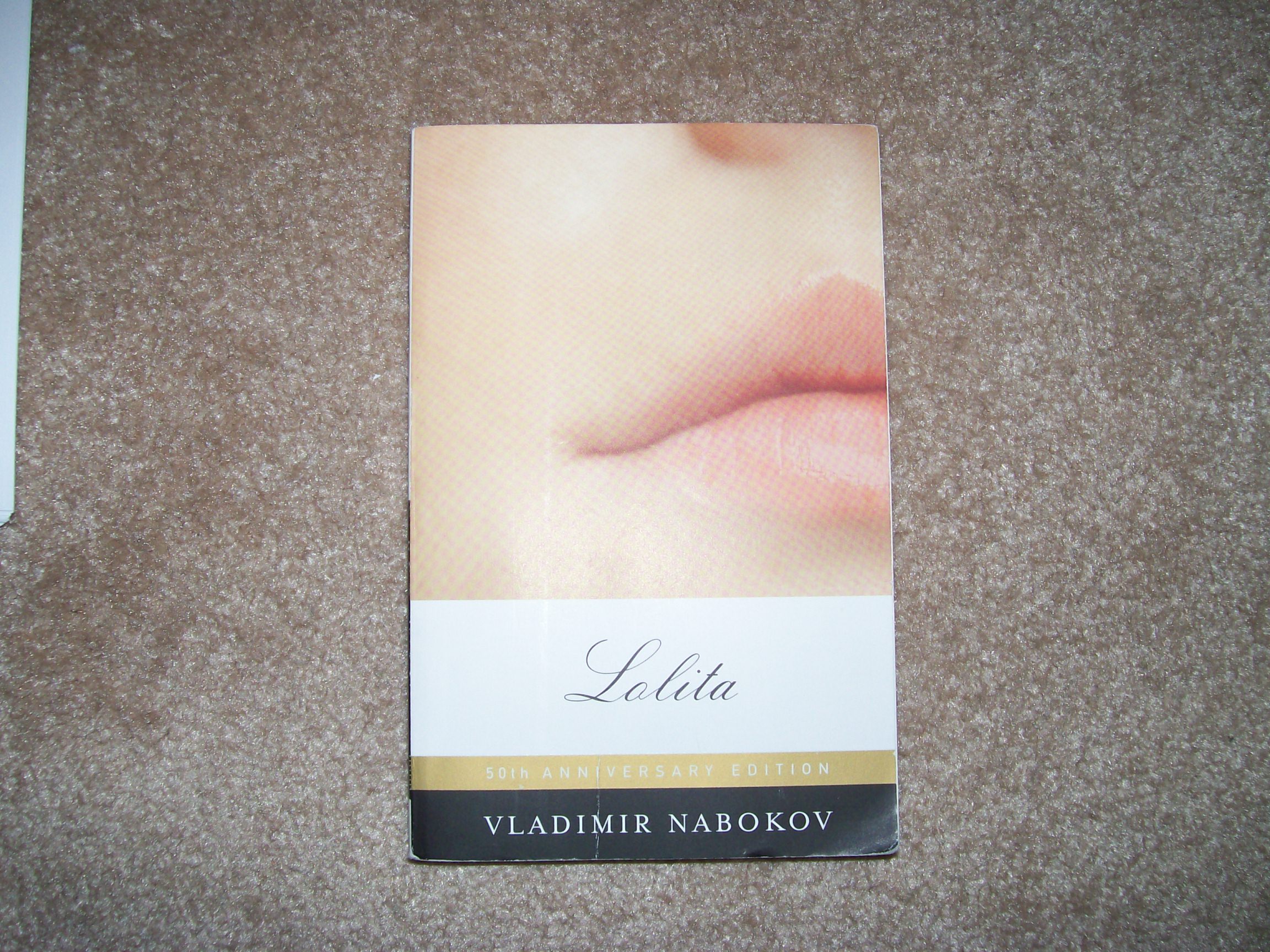
I don’t like to pick just one, but if I’m forced to do so, the answer is: “Lolita” by Vladimir Nabokov.
My copy of Lolita.My marked copy of Lolita.
Why? Because the language is gorgeous. Think about it. Russian author. Written originally in English. French-speaking narrator.
Wow.
I hate Humbert. Yes, I hate the protagonist but love the book. He intrigues me yet disgusts me. His obsession with nymphets is twisted. I have a hard time relating to his specific obsession. But we’re all obsessed by something. So I can relate there.
Characters’ obsessions (and people in real life) are fascinating. They can tell us about the secret parts of ourselves that we don’t know exist. Characters often have the same ones as us, or ones we can relate to, or wants we discover we had and never voiced to ourselves, or a desire we explore with the characters.
I was a coward once. A space traveler who had a fear of open spaces. A bug terminator afraid to be near anything with more than four legs.
Okay, so maybe more than once.
But that’s not the point.
So what is the point? The fact that I overcame those fears. Eventually. With a lot of hard work. And effort. I tried and tried again. Exposed myself to large spaces where anything could happen to letting bugs crawl over my toes and fingers without moving to flick them off.
I’m still a coward. But I can be in open spaces and touch anything that legs, especially if they have more than four.
I’m getting ready for the fall semester at Bowling Green State University. The first day of class is Monday.
For my fiction workshop, I’ll be reading “Twilight” by William Gay, “Bean Trees” by Barbara Kingsolver, “Building Fiction” by Jesse Lee Kercheval, “Making Shapely Fiction” by Jerome Stern, and “On Becoming A Novelist” by John Gardner.
I’m also taking Native American Literature and Modern Fiction.
The texts for Native American Literature are: “American Indian Trickster Tales” by Richard Erdoes and Alfonso Ortiz, “Dwellings” by Linda Hogan, “Genocide of the Mind” by MariJo Moore, “Lame Deer, seeker of Visions” by Lame Deer, “The Lone Ranger and Tonto Fistfight in Heaven” by Sherman Alexie, and “Love Medicine” by Louise Erdrich.
Modern Fiction reading includes: “Cane” by Jean Toomer, Carson McCullers’ novels, Franz Kafka’s complete short stories, “Kafka Was the Rage” by Anatole Broyard, William Faulkner’s novels, “Selected Short Stories of William Faulkner,”
“Street of Crocodiles” by Bruno Schulz, “Tobacco Road” by Erskine Caldwell, “Winesburg, Ohio” by Sherwood Anderson, and “Winter’s Tales” by Isak Dinesen.
I’ll talk about these texts as I read them over the course of the semester. Feel free to pick up a copy yourself!
Paul Jacobs commented “It’s a beautiful addiction to have.”
What do you think is a ‘beautiful addiction’? Write about it.
If it is any evidence to you
of the stacks on my floor
and several bookcases
filled to the brim,
I am addicted to bound
pages of words.
A beautiful addiction.
I have never liked spiders or ants. I would scream, freeze, or smash them whenever I saw them. Yet earlier this summer I wrote a short story about spiders. The last couple of days I’ve been working on a short story about ants. Writing a story about something I don’t like or fear removes the fear, at least partially. Today if I am surprised by spiders or ants, I freak out once in a while. I discovered bags of eucalyptus tea in dark corners work marvelously as a spider repellant. Last night I researched ant repellents. Eucalyptus is shown to work sometimes to repel ants too.
It’s strange where writing takes you. The benefit is that I don’t screech like I used to when I see them. At least I learned something to use for real life while working on stories.
Now if only I could find a story idea for fireflies. I like them.
Two important writing tools that I use when I revise are readability and www.wordle.net.
I learned of the readability feature in Microsoft Word from “The Writer’s Little Helper” by James V. Smith, Jr. To turn on the readability feature is simple. When you spell check a document, click on options and select “show readability statistics.” Then after spell check, a box will appear with numbers. According to Smith the ones to shoot for are:
Words per sentence (average): 15 maximum
Characters per word (average): 4.5 maximum
Passive voice: 5 percent maximum
Flesch Reading Ease: 80 percent minimum
Flesch-Kincaid Level: 6 maximum
Although with the Flesch Reading Ease, I’m happy with 65 to 75 percent and with the Flesch-Kincaid Level 7 or 8 is great. But it all depends on who your audience is and your goals for the piece. I try to keep the Flesch scales consistent around a certain range for a piece, letting the style dictate the range. The passive voice number is very important because passive sentences are definitely weaker than active ones.
Wordle is a handy tool I picked up from National Novel Writing Month. Go to http://www.wordle.net and click “Create.” Paste the text of your short story, for example, and then click “Go.” The site creates a picture (or word cloud) of the words used most often in the text. I for one use “that” and “just” too often. So wordle is a great tool to see which words you overuse and then try to weed those from your work.
Both readability and wordle have helped me cut unnecessary words from my writing. Tighter prose is cleaner and easier to read and convey information.
If you would like to see a word cloud of this post, click below:
“He ached from head to foot, all zones of pain seemingly interdependent. He was rather like a Christmas tree whose lights, wired in series, must all go out if even one bulb is defective.” (161)
The quote above is from J.D. Salinger’s “Nine Stories,” specifically the short story “For Esme—with Love and Squalor.” Reading these two sentences inspired me to write more creative similes that go beyond the figurative language to add more details to the character’s mindset.
Brainstorm a list of 5 similes (or metaphors) and use one in a piece of writing.
My list of five:
1. She curled up in bed with a cup of hot tea and biscuits to read the latest fashion magazine like a turtle who decided to stay in her shell.
2. Christopher sat down like a mouse ready to nibble his captured cheese.
3. She cleaned with a fury that defied the demons she trapped inside.
4. Like an excited child when the paint was released, she was ready to dig in to the parenting books from the library.
5. Charla’s dog jumped up and licked every visitor’s chin, like an extroverted human without a leash.
She cleaned with a fury
that defied the demons
she had strapped inside,
locked into a cage,
never to be released,
certainly not by her,
and then she met him.
He had more demons
than she expected,
locked in his own cellar.
I started my first novel in May 2004. I worked on the story idea, expanding it into a two-book series. I wrote both during National Novel Writing Months, in November 2009 and November 2010. (Find out more here: http://www.nanowrimo.org/.) But I decided to take a break since I wrote on and off for years. And instead of two novels, just rewrite the one novel at a later time.
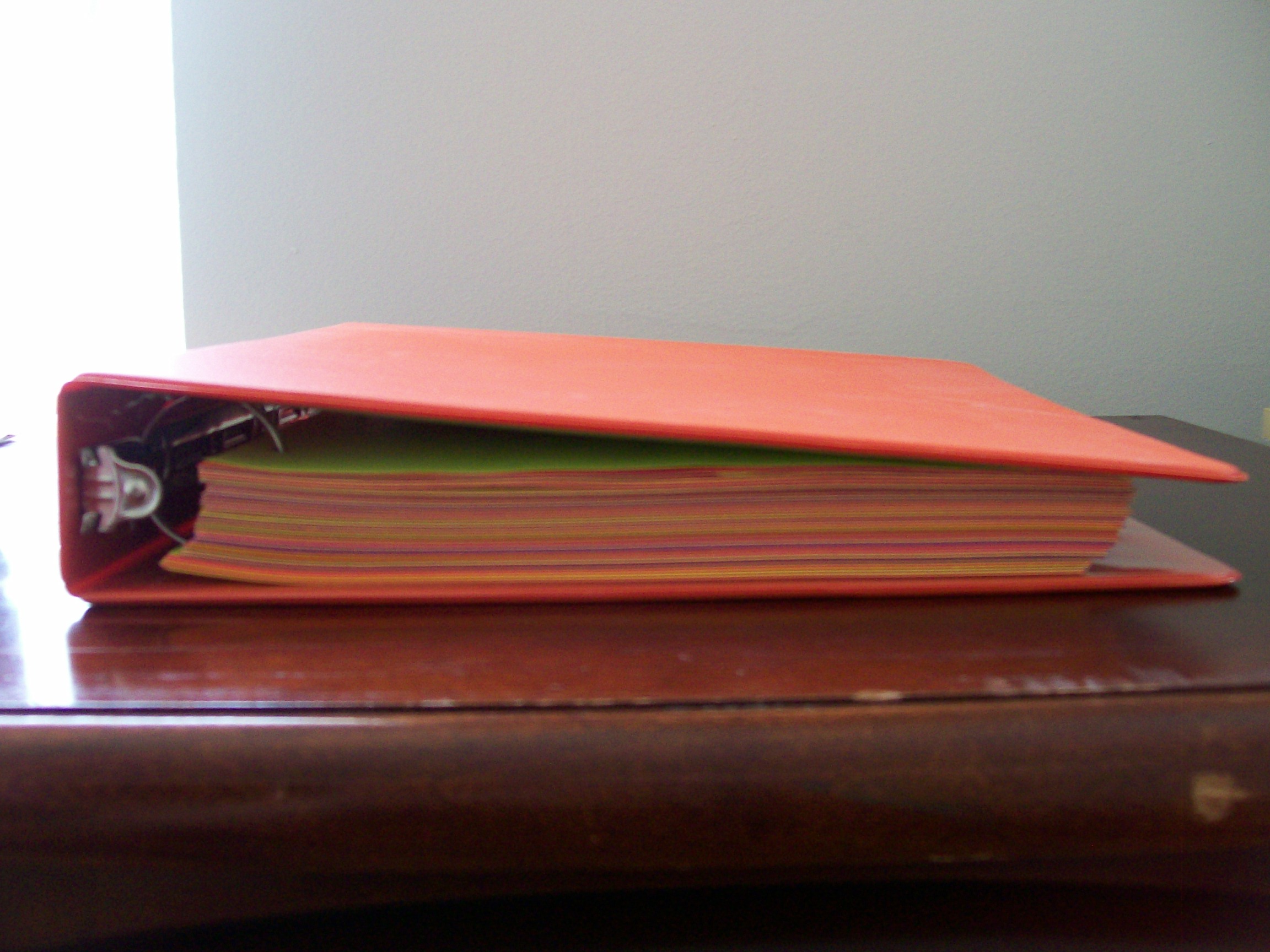
Since April I’ve been working on a different novel, and I worked on editing it yesterday and today. Here is a picture of the second draft:
This is the second draft of the novel I've been working on since April. It is 187 pages, double spaced, single sided.
Compared to the first draft:
The first draft of my April Novel. Note that it is uneven because I wrote the scenes out of order. I used colored paper to rearrange them.
Other novel ideas have landed in my pond over the years. I decided to participate in NaNoWriMo this year. After last year’s NaNoWriMo I wasn’t planning on it because I wasn’t sure I wanted to focus on a word count when I want to write quality fiction. But since I wrote 42 thousand words in 16 days in April, I realized that I couldn’t have done it without my NaNoWriMo experience, so I’m going to continue to participate.
As for my other novel ideas, I’m researching before writing.

 Suzanna and Writing