Lily Blooms and All
The lily bloomed.

I made sourdough.

And crocheted a wine bottle cozy–my first ever.
 With less than a week left for the poetry project, I’ve been able to write a poem a day about the bracelets. It has been an interesting project to work on every day. I think my next two-week poem-a-day project will be about hands.
I started reading “The Unbearable Lightness of Being” by Milan Kundera. I’m really enjoying it so far. More to come.
Prompt–Sunday, February 12
I finished reading “Griffin & Sabine: An Extraordinary Correspondence” by Nick Bantock. It is a novel in letters. One of the lines that caught my attention was in one of Griffin’s letter: “Art for art’s sake is best quarantined here in the old world. I crave an art that passionately transcends the mundane instead of being a device for self-deception.”
Write a letter to Griffin.
Dear Griffin,
I appreciate the strange nature that led me to your letters. Yes I feel guilty for reading your mail, but there it is. They landed in my lap and I was intrigued by the art and the stamps. Next time I will have to make you a postcard instead of typing. I wonder if you have an email address.
In one letter you wrote to Sabine, you said, “Art for art’s sake is best quarantined here in the old world. I crave an art that passionately transcends the mundane instead of being a device for self-deception.”
Art can be a way to deceive the artist, but art is also a way for the artist to present themselves to the world. Personally I ask art questions of myself. Rarely it answers. Mostly it raises more questions.
At first I didn’t care for literary fiction. How could reality be interesting when I grew up reading fantasy and science fiction? It wasn’t until several literary fiction novels caught my interest that I began to pay more attention to reality in my own writing. Some of the titles are “Extremely Loud & Incredibly Close” by Jonathan Safran Foer and “Room” by Emma Donoghue.
Thank you for reading this strange letter.
Sincerely,
Suzanna
New! Lily and Poetry Project
I bought some bracelets from a seller on Etsy. The words on the bracelets are “I love you” and “I know” from Star Wars. I started wearing them every day and thought, “Why not write a poem every day using the bracelets as inspiration?” For two weeks I’ll write at least one poem a day. Today is day three. Poems for days one and two went well.
Last week I started to fence. It turns out tennis has helped my footwork, but it’ll take time to get used to holding a foil and sparing.
And I bought my first lily.

Suzanna means "lily" in Hebrew.
Another interesting week
I finished another journal this past week. When I was a kid I wrote in journals/diaries about every three years. Since I started journaling regularly in January 2011, I’m on my fourth journal. Hopefully the new one lasts for four months.
Reading a short story a day has not been successful. It isn’t a habit yet. Some day.
I purchased the complete poems of Robert Frost and Anne Sexton. Super excited to delve into both, especially since I studied Frost in-depth in modern poetry and I’ve been told that I write like Anne Sexton.
The attempt at apricot bread failed. Let’s just say the bread fell in the middle and forget it happened.
I started reading “Finding Yourself in Transition” by Robert Brumet, and he had this to say about change: “A process is a change or a series of changes that occur over a period of time. A process usually has certain predetermined elements or phases that generally occur in a specific sequence or order. The phases or elements must each occur at the right time in the right order.” (Brumet 25). Immediately I thought of Joseph Campbell and the journey stories I’ve read.
There was a poster sale at school so I stopped by. Aren’t they great?

Star Wars, Phoenix and Imagination.
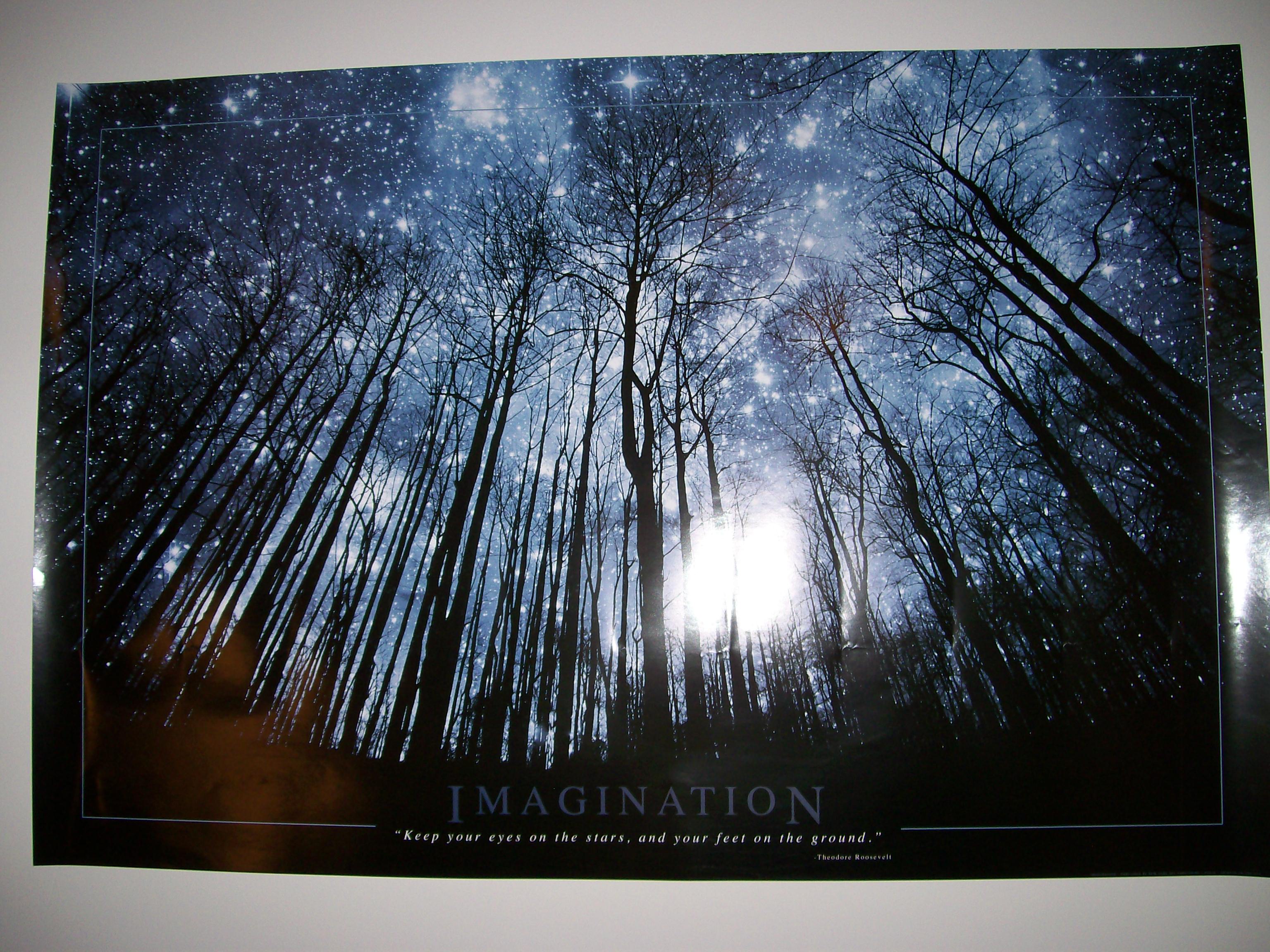
"Keep your eyes on the stars, and your feet on the ground."
Prompt–Sunday, February 5, 2012
Take the color red. Sven Tito Achen’s book “Symbols Around Us” says red can represent beautiful, popular, blood, life, emotion, passion, warmth, heat, fire, bloodshed, bravery, sacrifice, danger, love, war, battle, revolution, socialism, and communism. “In the Roman Catholic Church especially red also stands for the blood of the martyrs. Since 1245 it has been the distinctive color of cardinals. This last fact led Victor Hugo to call the lobster ‘the cardinal of the sea,’ to which a witty Norwegian retorted that it would have an apt simile if cardinals first turned red in purgatory”‘ (Achen 30).
Lobster
Red legs tread water
in retirement.
Closer to sun.
Grendel–John Gardner
For my contemporary fiction class we read “Grendel” by John Gardner. What strikes me most about the novel is the language and why we tell stories.

Some of my favorite lines:
- “Stars, spattered out through lifeless night from end to end, like jewels scattered in a dead king’s grave, tease, torment my wits toward meaningful patterns that do not exist.” (11)
- “Inside the hall I would hear the Shaper telling of the glorious deeds of dead kings–how they’d split certain heads, snuck away with precious swords and necklaces–his harp mimicking the rush of swords, clanging boldly with the noble speeches, sighing behind the heroes’ dying words. Whenever he stopped, thinking up formulas for what to say next, the people would all shout and thump each other and drink to the Shaper’s long life.” (34)
- “When he [Shaper] finished, the hall was as quiet as a mound. I too was silent, my ear pressed tight against the timbers. Even to me, incredibly, he had made it all seem true and very fine. Now a little, now more, a great roar began, an exhalation of breath that swelled to a rumble of voices and then to the howling and clapping and stomping of men gone mad on art. They would seize the oceans, the farthest stars, the deepest secret rivers in Hrothgar’s name! Men wept like children: children sat stunned. It went on and on, a fire more dread than any visible fire.” (43)
- “If the ideas of art were beautiful, that was art’s fault, not the Shaper’s.” (49)
- “It was a cold-blooded lie that a god had lovingly made the world and set out the sun and moon as lights to landdwellers, that brothers had fought, that one fo the races was saved, the other cursed. Yet he, the old Shaper, might make it true, by the sweetness of his harp, his cunning trickery. It came to me with a fierce jolt that I wanted it. As they did too, though vicious animals, cunning, cracked with theories. I wanted it, yes! Even if I must be the outcast, cursed by the rules of his hideous fable.” (55)
- “‘Except in the life of a hero, the whole world’s meaningless. The hero sees values beyond what’s possible. That’s the nature of a hero. It kills him, of course, ultimately. But it makes the whole struggle of humanity worthwhile.'” (89)
- “There have got to be stabler things than love.” (115)
- “I think of the pastness of the past: how the moment I am alive in, prisoned in, moves like a slowly tumbling form through darkness, the underground river.” (146)
- “Only in a world where everything is patently being lost can a priest stir men’s hearts as a poet would by maintaining that nothing is in vain.” (159)
As an artist and a writer in particular, I was really drawn to Gardner’s idea of what a Shaper is and how the Shaper can push people’s minds. Gardner explores why we tell stories.
The book covers many ideas like religion, hope versus cynicism, knowledge and wisdom, heroism, and art. You can read the novel without prior knowledge of “Beowulf,” but at least know that Beowulf was the original hero and Grendel the villain.
Gardner writes from Grendel’s point of view in the novel. Who is the hero in “Grendel”? I would argue there are multiple ones, including the Shaper, art, and Grendel.
Have you read “Grendel”? What do you think of the novel?
Prompt–Sunday, January 29
 I went to the Toledo Museum of Art Friday. When I go to museums, I love taking a notebook and working on ekphrasis (art in response to art). I usually write poetry, but fiction is known to happen.
One of the paintings that caught my eye was “The Old Church in Delft with the Tomb of Admiral Tromp” by Hendrick van Vliet.
The poem I wrote played with the form of echoes. So imagine a large room or cavern. Pick lines to repeat and then play with the order. Read it out loud to get the effect.
My lines:
The dead man’s tomb
rests in silence
as children play
step step step into light
let light filter
as pictures hang
columns stay strong
dogs walk past
My poem:
the dead man’s tomb
the dead man’s tomb
rests in silence
rests in silence
as children play
the dead man’s tomb
the dead man’s tomb
step step step into light
rests in silence
as children play
the dead man’s tomb
columns stay strong
dogs walk past
as children play
rests in silence
the dead man’s tomb
as pictures hang
the dead man’s tomb
the dead man’s tomb
rests in silence
as children play
let light filter
the dead man’s tomb
step step step into light
as pictures hang
columns stay strong
dogs walk past
the dead man’s tomb
the dead man’s tomb
rests in silence
rests in silence
rests in silence
Extremely Loud & Incredibly Close
Yesterday I saw the film “Extremely Loud & Incredibly Close” based on the book by Jonathan Safran Foer.

I read the book two years ago for class. The experimental nature of it with the addition of photographs and other elements enhanced the story for me. It became one of the novels I’ve recommended others to read.

And I have to say that this is one of my favorite novel-to-movie adaptations. The recurring images of the photographs were part of the film. Even though Grandma’s story was not part of the film, the film was complete in itself with its focus on Oskar and his relationship with his parents.
Not to mention that Alexandre Desplat wrote the original music for the film. He’s one of my favorite film composers, so of course I bought the soundtrack.
If you haven’t read the book or seen the film, put it on your to-read and to-watch list.
Prompt–Monday, January 23
The novel “Extremely Loud & Incredibly Close” by Jonathan Safran Foer uses photographs to accompany the story. Pick a project you’ve been working on and make a list of at least photographs or pictures or art that would enhance the story you’re trying to tell.
For my April Novel:
- magnolia tree
- phoenix
- museum painting
- stars
- her art
 Suzanna and Writing